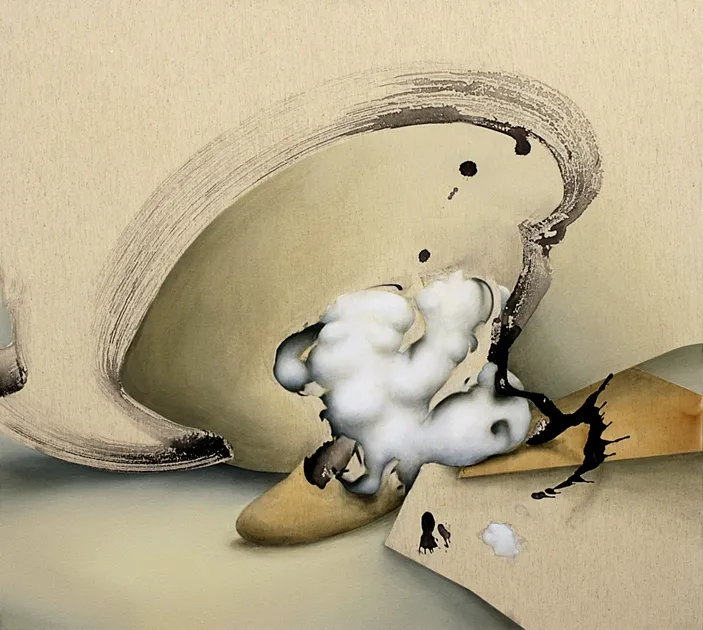
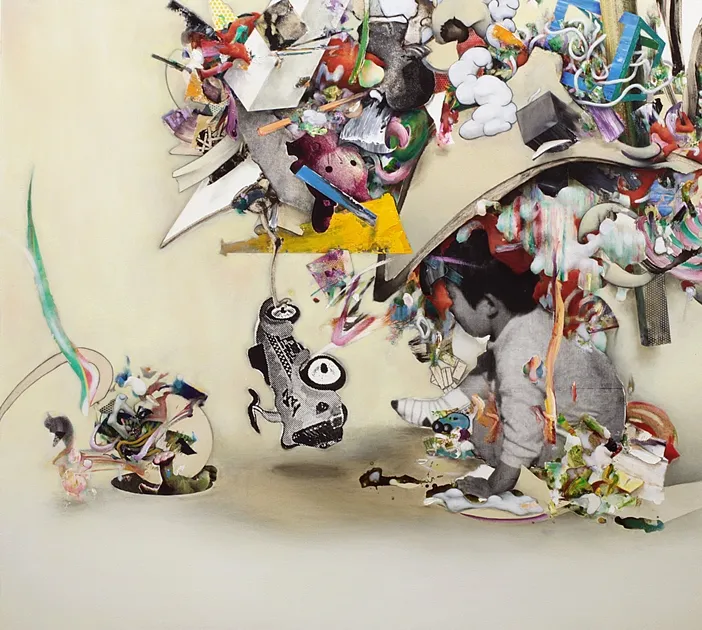
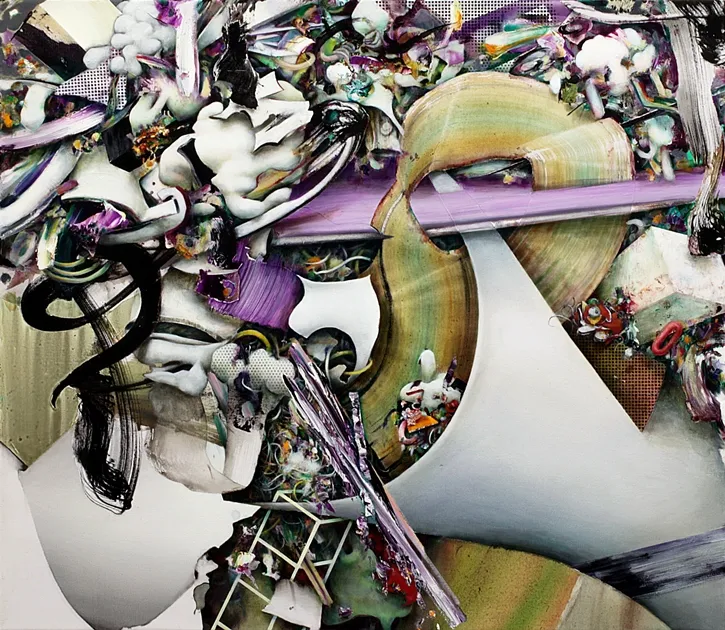
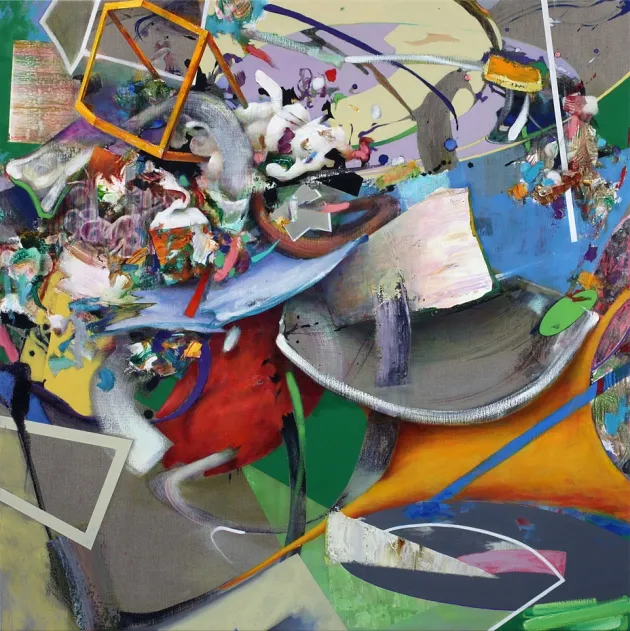
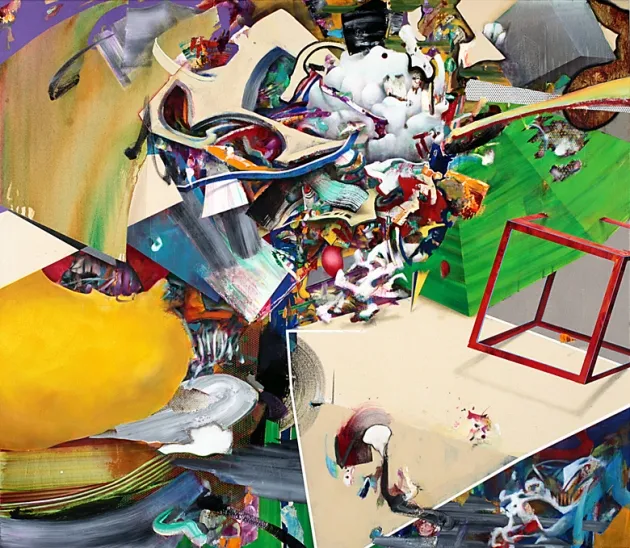
The “Albertian model” proposes to perceive a painting as “a window opened to another reality”. Modern Art stresses the surface of the canvas itself. Japanese artist Haruki Ogawa rethinks the basics of this topology. He perceives the canvas of painting as a plane that releases interplaying elements into the space in front. Discharging elements that are in process of multi-directed and synchronous transformation, while spreading and occupying space of the picture and “beyond”, paradoxically preserve its volumes, shades and effect of perspective. Ogawa works with hyper-dynamic three-dimensional abstraction, where non-concrete objects possess illusion of physical presence while keeping moving forward, around and back into the plane of the canvas.
In his recent paintings, while working on idea of “echo” and “resonance”, Ogawa develops the basic structure of the painting and using canvases of different colour tones and textures bring them into the visual dimension of depicted actions. For instance, “Correlation IV” consists of cotton-hemp (left part) and hemp (right part) canvases which participate in the painting interplaying and merging with depicted planes and semi-spheres. In this way, seemingly the closest to the viewer plane is actually in many cases the physical plane of the canvas itself which due to effects of shades and layers looks like painted and covering one.
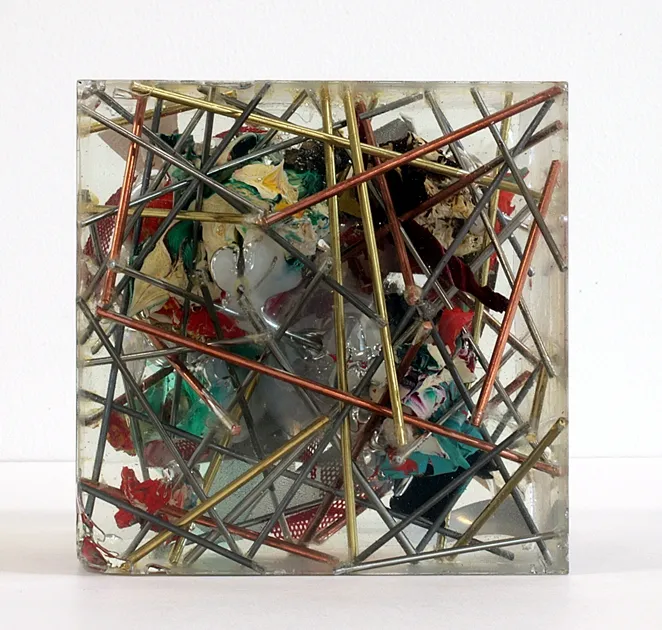
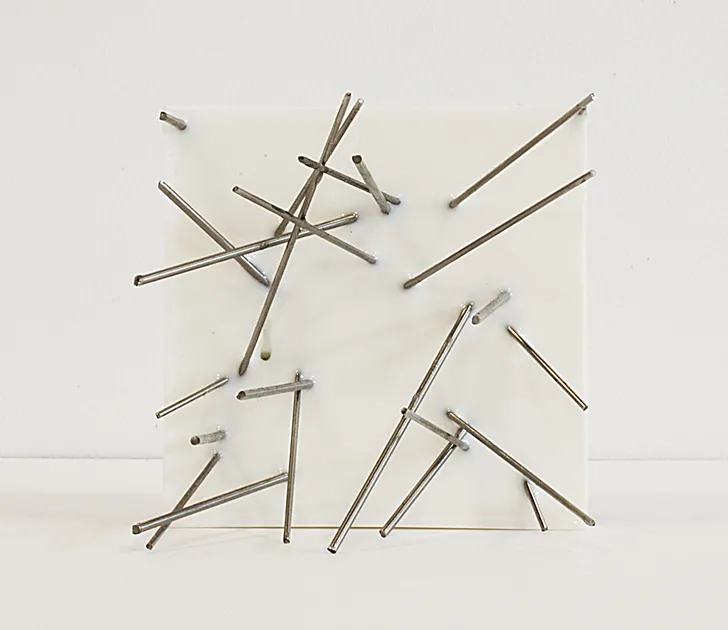
While expanding his artistic practise to another media, in his recent series of works called “Roentgenpainting” Ogawa experiments with coloured resin and matter of different texture and geometric qualities to expose the intriguing labyrinth of painting, which for the artist from the beginning was perceived not as a surface, but as an object. Roentgainpaintings puzzle the viewer with the complicated network of pictures elements when it is seen from the front side, reveals the layers of the structure separately when it is seen from the side and then complicates the image and perplex the viewer again showing visually inextricable knot of elements from the back. This way the object works as X-Rey machine that reviles for a moment a structure of “oil on canvas” usually hidden from the viewer.
This way Ogawa’s works become a fast expanding number of paradoxes of permanently shifting “further”-“closer”, “under”-“over” as well as “going out” – “coming in”. While triggering the endless play of patches, his painting-object unstoppably redefines itself, transforms, reconstructs itself in something different, and then something different, and different.